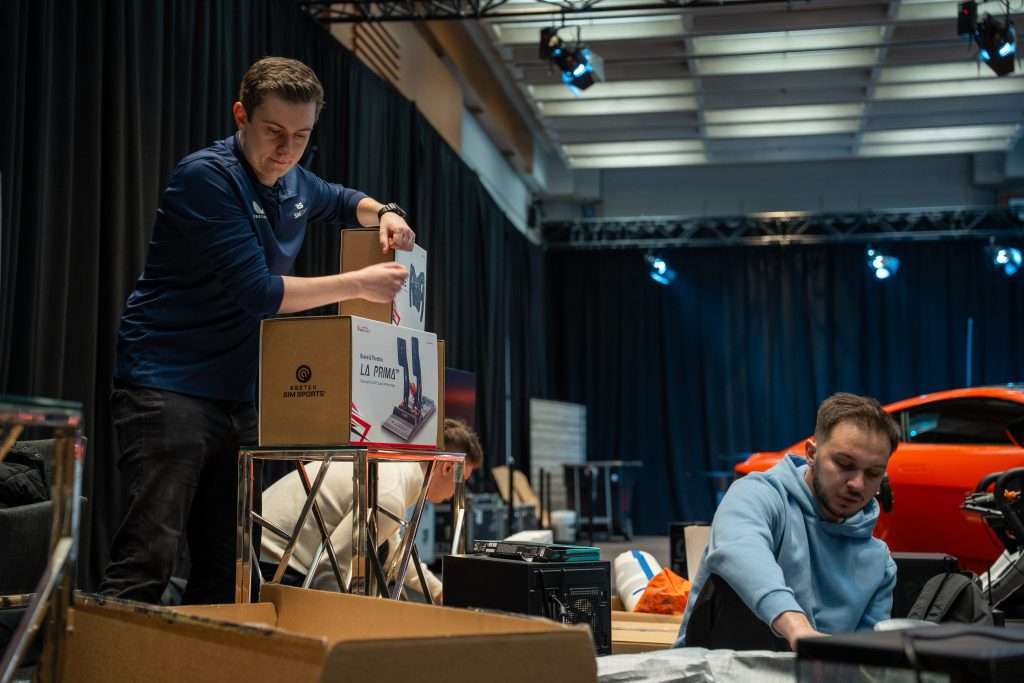
Sim racing’s expansion accelerated when the COVID-19 pandemic disrupted real-world motorsports. As enthusiasts and professional drivers were forced to stay home, many turned to online racing for their fix. When the 2020 24 Hours of Le Mans was postponed from June to September, a virtual version occupied its original slot in rFactor 2, bringing professional drivers and esports competitors together, which could be said to mark a milestone in sim racing’s growing visibility. Among them was Max Verstappen, whose enthusiasm for sim racing continued beyond lockdown, making many wonder whether Formula One is simply what he does between sim races.
The audience for sim racing content grew too. Jimmy Broadbent’s channel, for example, expanded from around 300,000 subscribers in January 2020 to around 600,000 by July 2021 (DriveTribe, 2021; Broadbent, 2024), later surpassing one million (Broadbent, 2025). Like other sim racing content creators who grew significantly during this period, Broadbent’s videos have introduced newcomers to what sim racing can offer, from modern competitive racing to motorsport’s many subcultures.
That variety also reflects Assetto Corsa’s enduring appeal. Released in 2014, this jack-of-all-trades simulator has maintained a substantial following, supported by its modding community and variety of racing disciplines. It averaged approximately 2,565 concurrent Steam players in February 2020, rising to 4,399 that April during lockdowns, an increase of around 72%. By August 2026, its monthly average had reached 8,634, more than three times the pre-lockdown figure, while its all-time peak of 20,019 simultaneous players in December 2025 was nearly four times February 2020’s peak of 5,278 (Steam Charts, n.d.). The hardware market has also expanded alongside these audiences, as shown by Asetek SimSports and MOZA both entering sim racing in 2021 and since releasing entire ecosystems of wheelbases, steering wheels, pedals, and accessories, giving the growing audience a broader choice of equipment.
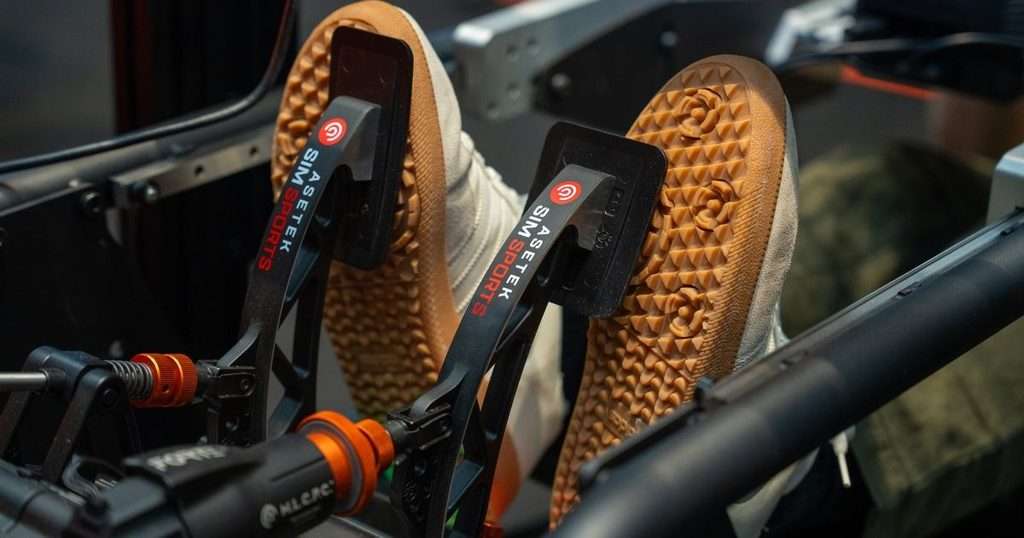
Image by SimStaff
These examples show the hobby’s growing reach, but what makes the experience so compelling? Understanding sim racing’s appeal requires looking beyond the increase in participants to why they participate and what keeps them coming back.
A racing life within reach
Every sim racer has experienced this at least 5 times: “Why don’t you just buy a real car?” It is a valid, though maybe ignorant, question. Why don’t you?
Buying the car is only the first item on a rather long shopping list. Track access, entry fees, travel, and the ongoing costs of fuel, parts, and tyres add up. Then there is the knowledge and time to maintain it, or the money to pay someone who can. Depending on how you intend to compete, racing licences and fireproof racewear may also join the shopping list.
This list probably ignores a myriad of other considerations, but it all points to lifestyle limitations. For many people, that lifestyle is simply out of reach, whether resource-wise or time-wise because of other obligations.
Owning a fast car and having had the chance to explore its limits safely are two very different things. Social media offers plenty of examples of the “straight-line 0–60 hero” archetype, often spotted leaving a cars-and-coffee event in a Mustang or one of its European cousins, usually from BMW’s F-series range, drivers who only discover the limit after crossing it. Public roads are no place to test those limits, but the point stands: owning a race car and having access to a circuit where you can explore and learn its capabilities under controlled conditions are very different things.
Real-world motorsport requires more money, time, and flexibility than many enthusiasts can spare. So while sim racing can be expensive, the initial investment can quickly pay for itself compared with the cost of regularly taking a real car onto a circuit. It also offers trial-and-error learning with a reset button, something its real-life counterpart does not have.
Racing as a part-time reality
With sim racing, you get to experience the appeal of being a racing driver without all the headaches that usually make that lifestyle a full-time job. But why choose such a demanding way to spend your free time? More accessible alternatives exist within the racing genre, with easier-to-pick-up game mechanics and affirmations like “that flatspin through that collapsing building was so masterful.” So why go through all the trouble of getting the gear and tackling the learning curve to race competitively? Do you even enjoy it? Because it just seems like extra labour that doesn’t seem all that appealing or enjoyable, on top of a long day at your real job.
The type of person whom sim racing attracts is someone whose mind drifts off constantly towards the next big thing they are going to go after in the sim racing world during that workday: “I need to put in 2 hours tonight, maybe into the late night, and 4 more tomorrow if I should have any chance of winning Saturday’s league race. Surely, I can function like a normal human being on 5 hours of sleep, right?” Such internal negotiations illustrate what Gordon Calleja calls macroinvolvement: the thoughts, plans, feelings, and activities that take place before and after playing a game, as opposed to microinvolvement, the moment-to-moment involvement during gameplay (2011, pp. 4, 37–40). Analysing telemetry, walking through a replay frame by frame, discussing setups, looking for deals on sim gear, and then tinkering endlessly with it can all extend the experience beyond the cockpit. This might itself be part of the appeal: taking on the identity of a (sim)racer, with aspects of that routine mirroring its real-life counterpart as a sort of ‘lite’ version of that lifestyle.
Such deep macroinvolvement in media experiences can sustain engagement beyond individual sessions, as the time between them becomes an opportunity for research, reflection, and planning, creating new reasons to return (Calleja, 2011, pp. 37–40). For players who embrace this depth, sim racing stands in stark contrast to an arcade-focused racer as a pick-up-and-play experience, where the appeal centres more on the immediate driving session than on preparation and reflection around it.
The enjoyment of mastering “reality”
In a competitive landscape of entertainment and enjoyable media experiences, we tend to choose what we expect will satisfy our particular needs (Sullivan, 2013, p. 113; pp. 120–121). As Vorderer, Steen and Chan (2006, pp. 6–8) discuss, these experiences can satisfy three basic psychological needs: a sense of competence, feeling that you can meet and overcome the challenge the experience presents; relatedness, feeling connected to teammates or competitors sharing the experience; and autonomy, feeling that you are participating willingly, guided by your own interests.
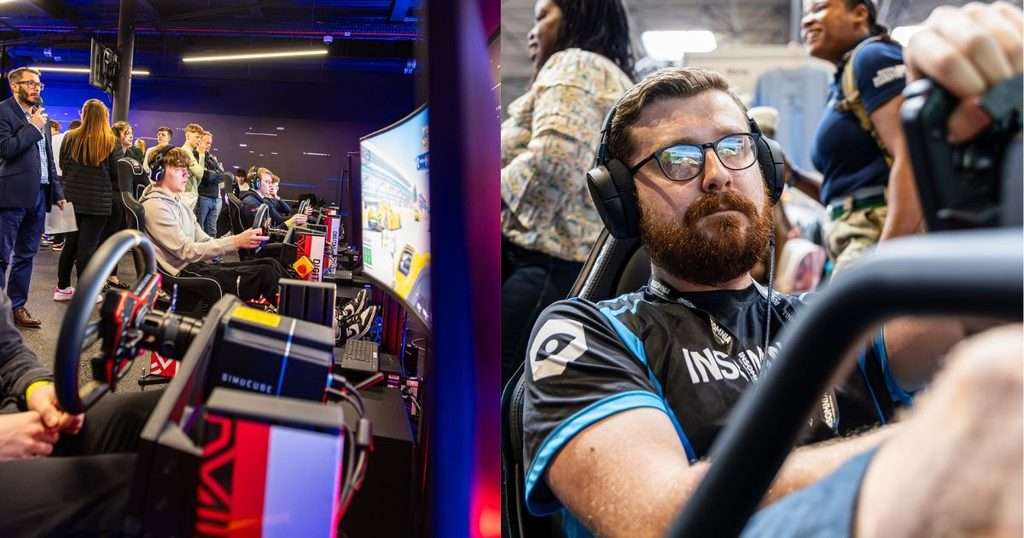
Images by SimStaff
While the latter two characteristics seem obvious in sim racing, gaining competence is what makes the hobby especially interesting to participants. Real motorsport is usually out of reach for “mere mortals” and would almost exclusively be reserved for passive viewing on a broadcast had sim racing not existed. It is one thing to learn what a racing driver does by watching and listening to commentators describe what they are doing; it is another to actively participate, with your own body, in a simulated version. Making driving inputs and decisions corresponding to those of real racing drivers, and learning through that kinaesthetic experience, is an essential part of the journey many sim racers embark on. For these enthusiasts, passive participation is never enough.
A perhaps extreme but particularly telling example of this sentiment is displayed by YouTuber Jake “GPLaps” William, whose channel’s ethos and raison d’être could be said to centre on getting closer to different eras of motorsport history via sim racing, allowing enthusiasts to experience aspects of historical racing otherwise beyond their reach due to limited resources and the obvious temporal constraints. This is exemplified perfectly in his experiment testing 1950s Formula driving techniques, based on literature from the era, including writings by Grand Prix ace Piero Taruffi. This shows how sim racing lets enthusiasts put historical techniques into practice, bringing them closer to active participation in a racing experience than documentaries or books alone could.
The immersive experience, perceived as true-to-life, can give what the player learns added significance and strengthen their desire to improve. Someone drawn to the demanding simulator experience may willingly approach its steep learning curve because it offers a way to explore the challenges of real-world motor racing through the means available to them. That willingness can be supported by the concept of self-efficacy: the belief, or self-assessment, that they can perform the actions needed to meet and overcome those challenges. According to Klimmt and Hartmann (2006, pp. 160–164), this belief can influence which games people choose, how much effort they invest in mastering them, and whether they persist when difficulties arise. It helps explain the commitment behind those imagined internal negotiations like the aforementioned ones: “I do not have the pace yet, but with two hours tonight and five tomorrow evening, I might be ready for this week’s race.”
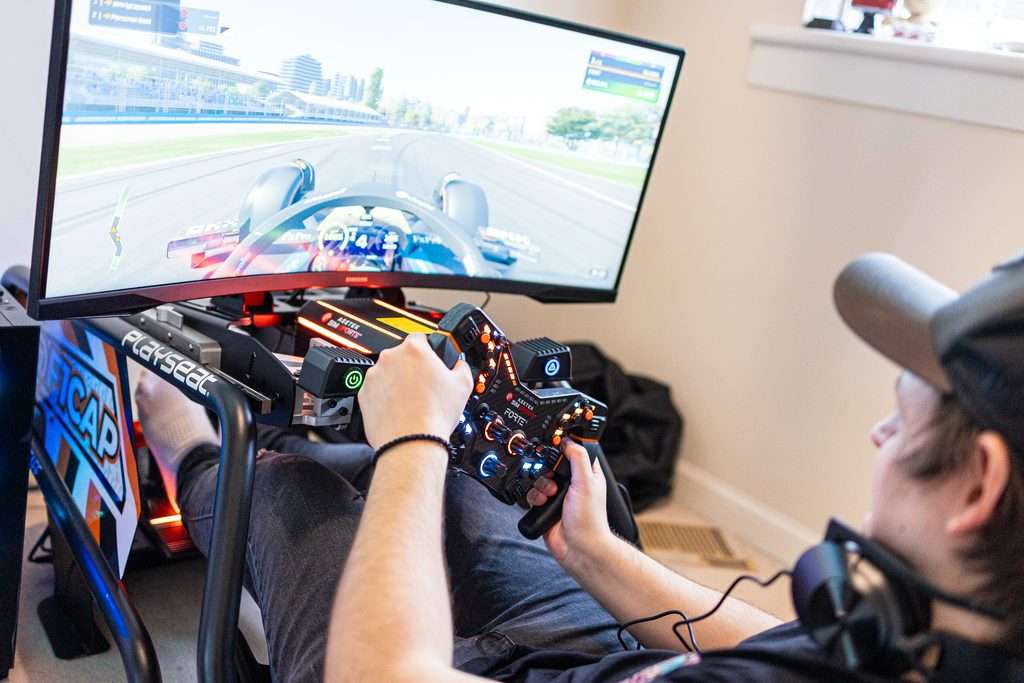
Image by SimStaff
By the same token, someone deeply invested in sim racing may find that an arcade-style racer does not offer the same satisfaction they have grown accustomed to. Its over-the-top action might pull them out of the experience, while its simplification of the causal relationships involved in real-world driving may remove the steep demands they enjoy mastering. Their expectations and abilities have developed through practice, changing what they notice and find rewarding. A pick-up-and-play experience that feels too easy to master might therefore become boring, even if it explodes across auditory and visual channels; the particular challenge they seek simply isn’t there.
This connects to the concept of flow: an absorbing, enjoyable experience supported by a balance between skill and challenge, alongside clear goals, rules, and feedback on progress. If a task feels too easy relative to the player’s abilities, boredom can replace that absorption; if it feels beyond their capabilities, frustration or anxiety can arise (Sherry, 2004, pp. 332–333). An arcade racing game can also provide this balance, but its particular demands may not exercise the driving skills that this player wants to develop. For someone motivated to master simulated racing, those demands can be central to the enjoyment. If another game feels insufficiently challenging relative to their developed skills, achieving flow may be more difficult.
Motorsport, real or virtual, lends itself particularly well to creating the conditions for flow in its very structure. A timed lap provides a clear goal: completing the same circuit faster than your previous best or an opponent’s reference time. The delta bar especially makes feedback on your performance immediately visible, showing where you gain or lose time, and keeping it green after fighting so hard to find those hundredths can become an absorbing challenge.
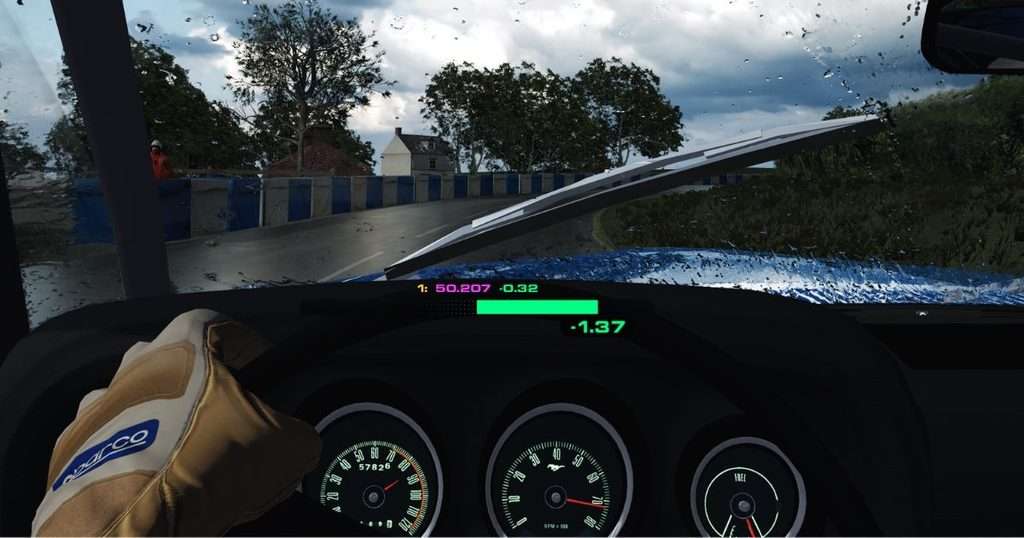
Sources: CMRT Group / Kunos Simulazioni
Flow involves intense concentration on a limited field of stimuli (Csikszentmihalyi, 1997, as cited in Jin, 2011, p. 118), while a balance between skill and challenge can make the activity intrinsically rewarding (Sherry, 2004, p. 332). In the simulator, that absorption might mean your attention centres on the car, the next corner, and coordinating your hands and feet. Fighting to keep the delta green and succeeding at it can, in the moment, feel like performing the equivalent of a Danny Carey drum solo, especially if you are driving a manual H-pattern car, involving the perfect execution of heel-toe-shifting. And once you set that lap time, perhaps one that shoots you to the top of the leaderboard, everything you have learned feeds into another attempt. Your new personal best becomes the next target, and you find yourself aching to make the bar go green again.
“Going native” in the community (and the gear obsession)
Relatedness, as mentioned earlier, helps explain the enjoyment of sharing an activity with others (Vorderer, Steen & Chan, 2006, pp. 6–8). Thanks to social spaces like Reddit or Discord, being a sim racing ‘nerd’ can feel less isolating, and because you exceedingly rarely encounter fellow sim racers in your offline surroundings, staying in contact with like-minded travellers down the sim racing rabbit hole can become a valued part of the hobby, which can lead to long-lasting friendships.
Racing with others, whether as rivals or teammates, is why many stay in the sim racing space, especially those looking for more than hotlapping or racing against AI. Joining a league and seeing the same familiar names again and again, either ahead of you or in your rearview mirror, can become a central driving force behind an individual’s involvement with the space. Putting in the time to compete with recurring rivals from week to week soon becomes something that also fills your thoughts beyond sitting in the cockpit. Finishing fifteenth in the weekly league race might feel like a loss due to all the effort you put in, but if you finally beat someone you have spent weeks chasing, even if they live rent-free in your head, it is still a victory.
At the collaborative end of the experience, sharing a car with teammates in a 4-, 6-, 12-, or even 24-hour endurance race is something very different from what other multiplayer experiences can offer. Working together by sharing setup knowledge, discussing the track and strategy, or analysing telemetry and replays to improve your collective performance brings people together. Staying up late into the morning hours to keep the current driver company and provide race-engineer support, and watching the virtual sunrise together adds a unique social dimension to that teamwork. The next race becomes more than another chance to improve your results: it is an appointment with people who know you, expect you, and notice when you are missing.
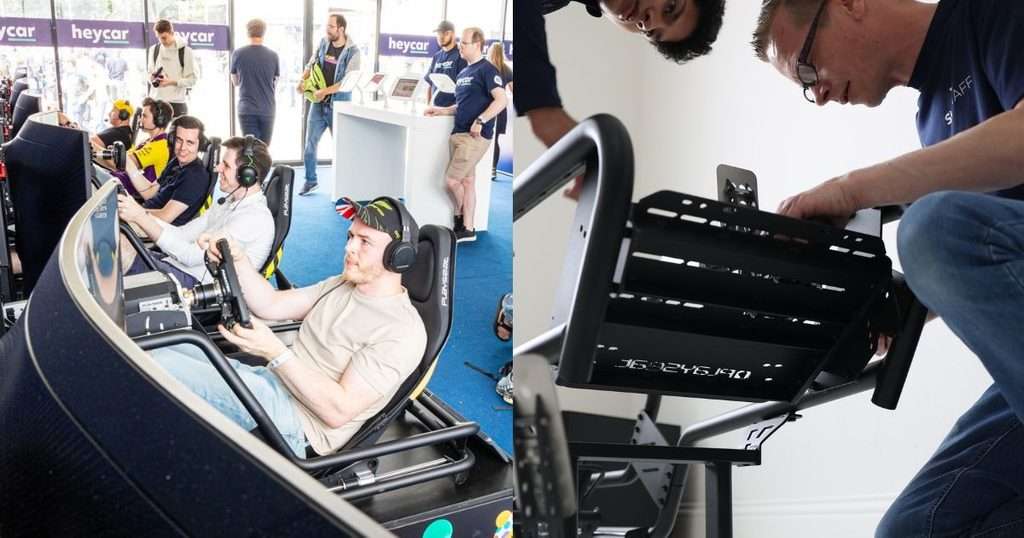
Images by SimStaff
That “rabbit hole” nature of sim racing often also revolves around the gear that enables the immersive experience. Browsing reviews, comment sections, and forum threads can make it sound as if there is a modern, ‘near-cyberpunk’ interpretation of the cave allegory unfolding as told by people who are further ahead on their gear-journey: motion-rig users “can’t go back” to stationary rigs, VR users “can’t go back” to flat screens, and direct-drive users can “never, ever” return to an old Logitech gear-driven wheelbase. These discussions regularly come up when people compare setups, and their experiences can help inform your purchasing decisions as you move further into the hobby.
This kind of research matters before investing in new gear. While generalist gaming and hardware news publications do cover sim racing equipment, a review may not answer every question about how a product will fit your particular setup and use cases. Specialist creators and fellow racers in your immediate community can add detailed comparisons, setup advice, and experiences gathered over time, making community discussions a crucial part of researching an upgrade.
Product specs provide only one part of the picture, so these conversations help you understand how those features translate into the driving experience. A great example is when you finally decide to make the jump to VR, and then four people in your close-knit community decide to follow your lead, all soon to be claiming they can never go back to monitor-racing. A friend’s recommendation can then make all the difference, as much as it can with discussions about LPs versus streaming, automatic watches versus quartz or smartwatches, and audiophile headphones versus gaming headsets.
The same scrutiny extends to how the community distinguishes a sim from something it considers less convincing: what feels “correct” and what feels “incorrect.” Whenever a new sim title appears, discussions emerge about where it belongs on the racing genre spectrum, from “true simulators” to sim-cades and arcade racers. A developer or publisher calling a title a “true-to-life simulator” does not guarantee enthusiasts will recognise it as one. The label may help win over some players ahead of launch, but it also invites public scrutiny: community members question and test the claims of realism, compare them with the actual driving experience, and call out what they consider empty marketing.
Players approach new releases with expectations informed by previous games, community discussions, and their understanding of motorsport. They also consider the opinions of ‘full-metal’ racing drivers drawing on real-world experience. Through these exchanges, players sometimes arrive at a considerably different interpretation of what the new title proposes is “real.” This illustrates an interpretative community: people from different groups who develop similar interpretations through shared interests, demographic similarities, or previous experiences. These ways of interpreting media are learned rather than natural or universal and exist before someone encounters a particular media text, shaping how they understand it (Fish, 1980, as cited in Sullivan, 2013, p. 155). Through these discussions, the community develops its own understanding of what counts as convincing simulated racing, helping define what it means to identify as a true “sim racer.”
Sources
Broadbent, J. (2024). How I Became A Full-Time Youtuber From A Garden Shed [Video]. YouTube. https://www.youtube.com/watch?v=jk0ofG7kq7U
Broadbent, J. (2025). Streaming until I hit 1 MILLION Subscribers [Video]. YouTube. https://www.youtube.com/watch?v=kPJgGQTq7UA
Calleja, G. (2011). In-game: From immersion to incorporation. MIT Press.
DriveTribe. (2021, July 25). Jimmy Broadbent has moved out of his shed! – House tour [Video]. YouTube. https://www.youtube.com/watch?v=JBMuyifuVxA
Jin, S. A. A. (2011). “I feel present. Therefore, I experience flow”: A structural equation modeling approach to flow and presence in video games. Journal of Broadcasting & Electronic Media, 55(1), 114–136.
Klimmt, C., & Hartmann, T. (2006). Effectance, self-efficacy, and the motivation to play video games. In P. Vorderer & J. Bryant (Eds.), Playing video games: Motives, responses, and consequences (pp. 153–168). Lawrence Erlbaum Associates.
Sherry, J. L. (2004). Flow and media enjoyment. Communication Theory, 14(4), 328–347. https://doi.org/10.1111/j.1468-2885.2004.tb00318.x
Steam Charts. (n.d.). Assetto Corsa. Retrieved September 20, 2026, from https://steamcharts.com/app/244210
Sullivan, J. L. (2013). Media audiences: Effects, users, institutions, and power. SAGE Publications.
Vorderer, P., Steen, F. F., & Chan, E. (2006). Motivation. In J. Bryant & P. Vorderer (Eds.), Psychology of entertainment (pp. 3–17). Lawrence Erlbaum Associates.