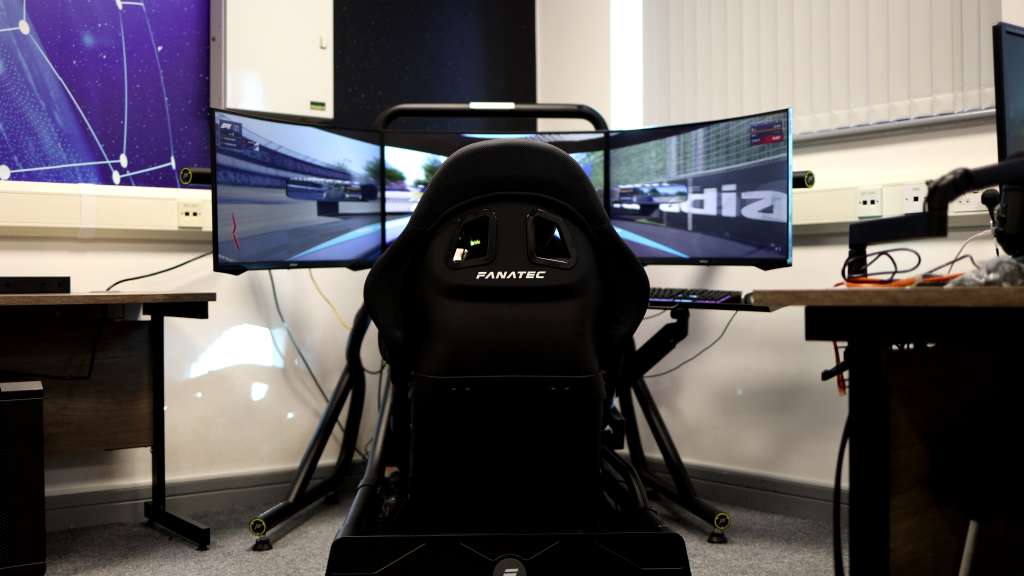
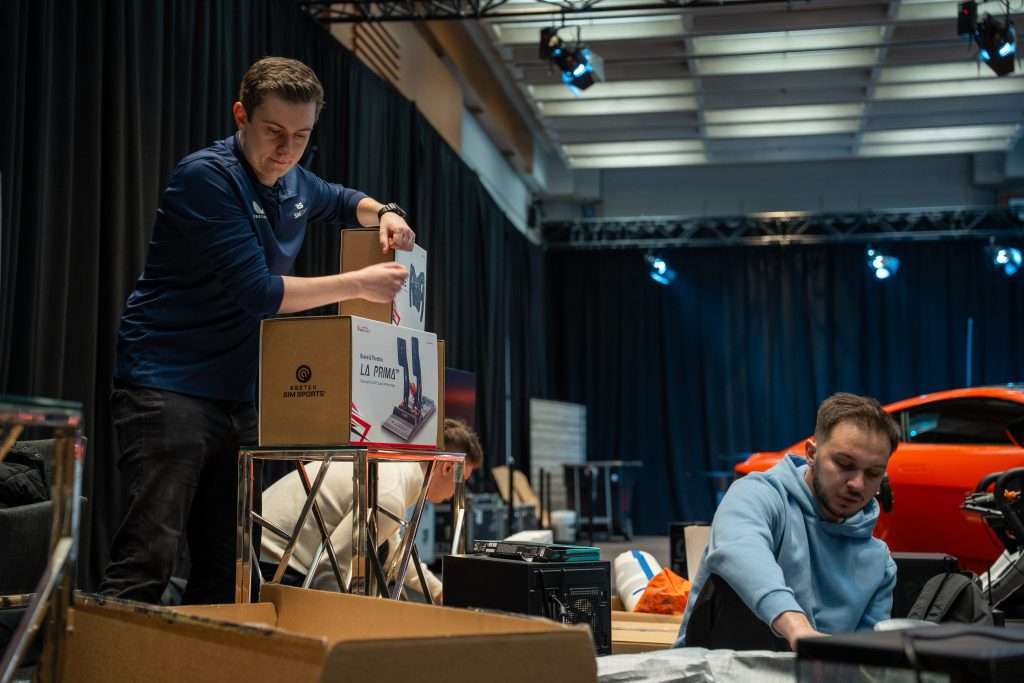
In every facet of entertainment, especially in interactive media such as video games, enjoyment usually stems from the selective preservation, adjustment, and, to some degree, simplification of the real-life causal relations of the targeted real-world phenomenon that is being simulated. Cause-and-effect relationships often feature exaggerated feedback through exploding on-screen score numbers and feel-good affirmations aimed at gamification goals, as seen in arcade entries in the racing genre. Here, racing up the sides of buildings, smashing through traffic, and spinning your car through the air without consequences are the norm; all designed in the name of fun.
At the other end of the arcade–simcade–simulator scale, sim racing takes an approach that seeks to preserve the causal relations of real motorsport as faithfully as possible, whether through the simulation software itself or the hardware used to experience it. Unfortunately, as is often the case, perhaps because sim racing is overshadowed by its more accessible and popular arcade cousins, with their spectacles and exploding colours, fans of the sim genre are frequently dismissed as merely “gamers” or “armchair racing drivers.” In this entry, we examine why such accusations miss the point entirely.

Photos by SimStaff
By breaking down the specific skills sim racing develops and examining how they transfer beyond the screen into the world of real motorsports, we will illustrate how modern simulators function not merely as games but as legitimate tools for improving real-world driving knowledge, ability, and decision-making.
The Basics: The Key Driving Skills Sim Racing Helps Develop
On a fundamental level, getting involved in sim racing before setting foot on a track can help build a strong skill foundation, putting you much further along than just going in blindly.
People who go tracking for the first time without any tuition will often adopt a hand position that leans more towards the ‘Vin Dieselian’ school of driving techniques. Learning why one should not do this by understeering into a virtual sandpit or barrier rather than the real thing is a valuable, entry-level lesson best learnt sooner rather than later.
On an elementary level, learning how to hold a steering wheel properly, which ideally is at 9 and 3, is a great habit to build, as many beginners, from their day-to-day habits or other inspirations, instinctively resort to either a 10-1 position or, as in the worst case presented above, drive with one hand at 12. The ideal hand positions provide a solid foundation for optimal car control with both hands firmly in place. It will generally serve you well on most tracks and allow rapid, split-second hand-over-hand corrections when circumstances require them.
In general, using a driving sim will help you nail all the real-world, transferable body movements required to manoeuvre a race car. That goes for braking as well, where you can practice threshold braking and trailbraking techniques. Getting a proper gut feeling for the amount of pressure one can apply before locking up the brakes and how late one can apply them in specific corners will help you in real life.

Photos by SimStaff
Braking late in a real-life practice session and finding the limit might, in the worst cases, have monetary or health-related consequences, but on the sim, you can always reset, rinse, and repeat the same process over and over again until you get it right, without needing a tow, or worse, an ambulance. In this way, learning how to balance the amount of steering input with your throttle and brake inputs soon becomes a string-connected motion, where you might soon find that moving one part of your body feels weird unless you move the other in tandem, as practised.
Another worthwhile skill you can prepare for in your day-to-day life, whether on the virtual or real track, is heel-toeing if you drive a manual-shifter-operated car. Sim-racer-turned-real-racer Jimmy Broadbent has mentioned this often, as he has learned it exclusively on the sim, which is a great benefit when driving h-pattern-based cars in general or historic cars in real life, which require this driving technique.
Working both to prevent the driven axle from locking up between downshifts and to practise healthy mechanical sympathy towards real cars, the string-connected movement inherent in the clutch–brake–throttle–gearshift sequence can be ingrained into your body via a simulator without risking potentially expensive transmission-related beginner mistakes in your real car. It is one of those things that, once you have mastered them, driving without them will feel ‘wrong’, both in the sim and in your day-to-day commute, which becomes especially counterintuitive as the latter rarely requires it, but still triggers the same learned response.
Mastering these fundamentals frees up mental bandwidth, enabling you to focus on achieving optimal speed through corner entry, the apex, and exit. Once internalised, these skills simplify mastering a particular track and serve as an excellent preparation tool for real-world driving. In general, racing simulators are excellent for learning how a car responds to braking and acceleration, including how its weight shifts forward and backwards, respectively. This understanding is crucial if you know you will soon be driving a Front-Wheel-Drive, Rear-Wheel-Drive, or All-Wheel-Drive car on track in real life and want to prepare. Each drivetrain layout handles differently, and each of them demands different types of driver inputs.
When it comes to learning how to manage oversteer and understeer, a racing sim is furthermore perfect for practising in various simulated weather and track conditions. iRacing, particularly with its rain-simulation feature, is ideal for practising real-life rain driving, as it accurately simulates dry racing lines that gradually form as cars pass through them over the span of a race, alongside puddles that also form along the track edges. Using it to practice managing such volatile grip conditions in a safe test environment is perfect, as it helps build muscle memory and reflexes should an emergency occur on track. Such use cases for the rain feature in iRacing are seen, for example, with Misha Charoudin, who uses it to keep his skills in the rain sharp, especially if he knows it will rain in a coming race.
Why Sim Racing Is Becoming a Legit Driver-Training Tool
With all the aforementioned areas of teaching nailed down, it then becomes clear what can be built on this foundation. As mentioned, when the moves become second nature, it frees up a lot of mental bandwidth to focus on forward-thinking driving.

Photo by SimStaff
Building familiarity with a track you might be driving in the near future is one of the biggest advantages of spending time in a racing sim. Actually learning the ebbs and flows of each section via haptic and visual cues is worth far more than just building a spatial mental model of a track from a map. Anticipating each curve, bump, and turn after experiencing them via high-fidelity force feedback in the sim creates highly transferable track familiarity, thanks to the tremendous amount of work that has gone into creating track models using LiDAR laser-scanning technology. Apart from the absence of felt elevation changes, the G-forces in your body and vibrations through the seat, it will be the closest you can come to feeling as if you are really there.
With the track knowledge in place, one can then move on to making context-based split-second decisions in high-pressure situations. Compared to slower day-to-day traffic, sim racing requires the user to gauge where many fast-moving parts currently are and to ascertain where they might be in five seconds, which dials the cognitive requirements up to eleven. Learning to read intent in virtual, but still very real, human adversaries and how they react to your manoeuvres in the sim can help you build pattern-recognition skills for how a similar IRL-racing situation might unfold, as the same tactics and movements will hold true across the two worlds. A very worthwhile ‘sixth-sense’ to build then is the ability to gauge how slower traffic might move, as seen in virtual multi-class races. Predicting moves from this type of ‘mobile obstacle’, and working your way past them, is no simple matter, which is why racing real humans instead of just AI will help build this skill better.
The most common transition for sim racers moving to IRL-racing often happens through track days, where a wide range of vehicles, varying in power and weight, is a constant factor to consider. In most cases, there will always be someone moving faster than you, so to keep out of their way, you will have to check your mirrors and blind spots constantly. On the sim, then, getting comfortable with driving a lower class in multi-class races, for example, a GT3 car, will be perfect training, as you will constantly have to check your mirrors for faster cars from the LMP and Hypercar classes. Failing to do so could spell doom for you and others, so learning this soon is crucial. We have all seen too many Nordschleife Touristenfahrten (near) accidents on YouTube that could have been prevented by strong mirror-shoulder-manoeuvre discipline, so consider this ability your ‘trigger-discipline’ for safety and awareness of others around you.
Photos by SimStaff
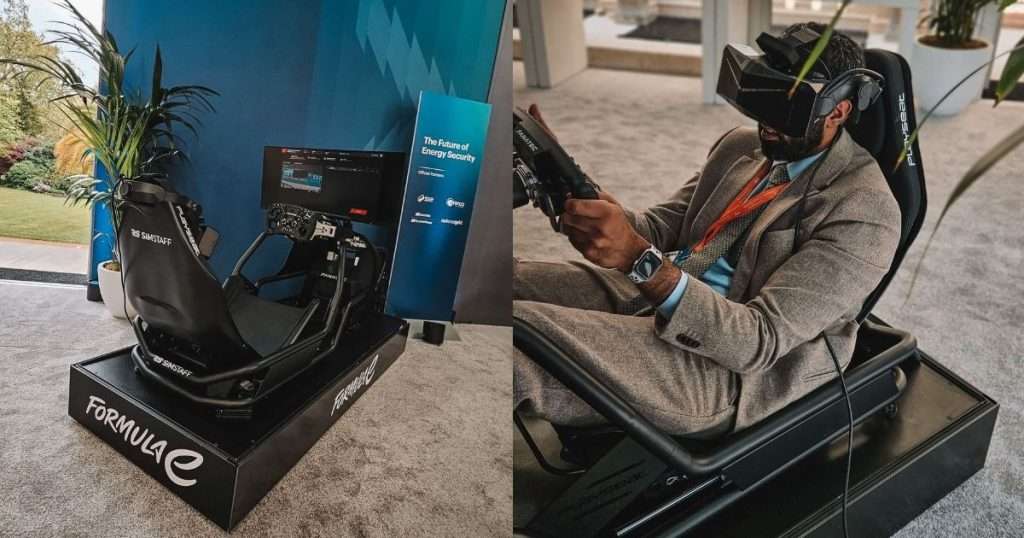
In this context, it is worth trying the Virtual Reality variant of sim racing if you are considering using a simulator as a training tool in the future, as gauging braking points and distances will feel much more like the real thing. VR has a long and proven history in training scenarios, for example, in military or aviation training, and can further help you build healthy, hyper-vigilant spatial awareness by forcing you to move your head and eyes constantly to check your mirrors and shoulders. After building a certain degree of motion sickness tolerance, you may find that training this level of vigilance carries over into everyday situations, making you more aware while driving or even when navigating crowded public spaces.
When to Call Us
Sim racing can develop fundamental skills that closely mirror those required for real-world motorsports. However, confidently transferring those skills from the simulator to actual roads or tracks can be challenging without a guiding hand.
Whether you’re preparing for another track day, entering real motorsport for the first time, or simply want to see what sim racing is all about, SimStaff can help you achieve whatever goal you set out to pursue. Whether it is guidance, equipment, or the technical know-how needed to get a smooth start, we are here to help you on your way.
Don’t hesitate to reach out to us for more details on how to enter the world of virtual motorsports.